370 Recycling
Oregon does not need a new crime. It needs to stop running the same people through the same expensive loop until someone is hurt.
One loop through the 161.370 system. Then the person is released. Then it happens again.
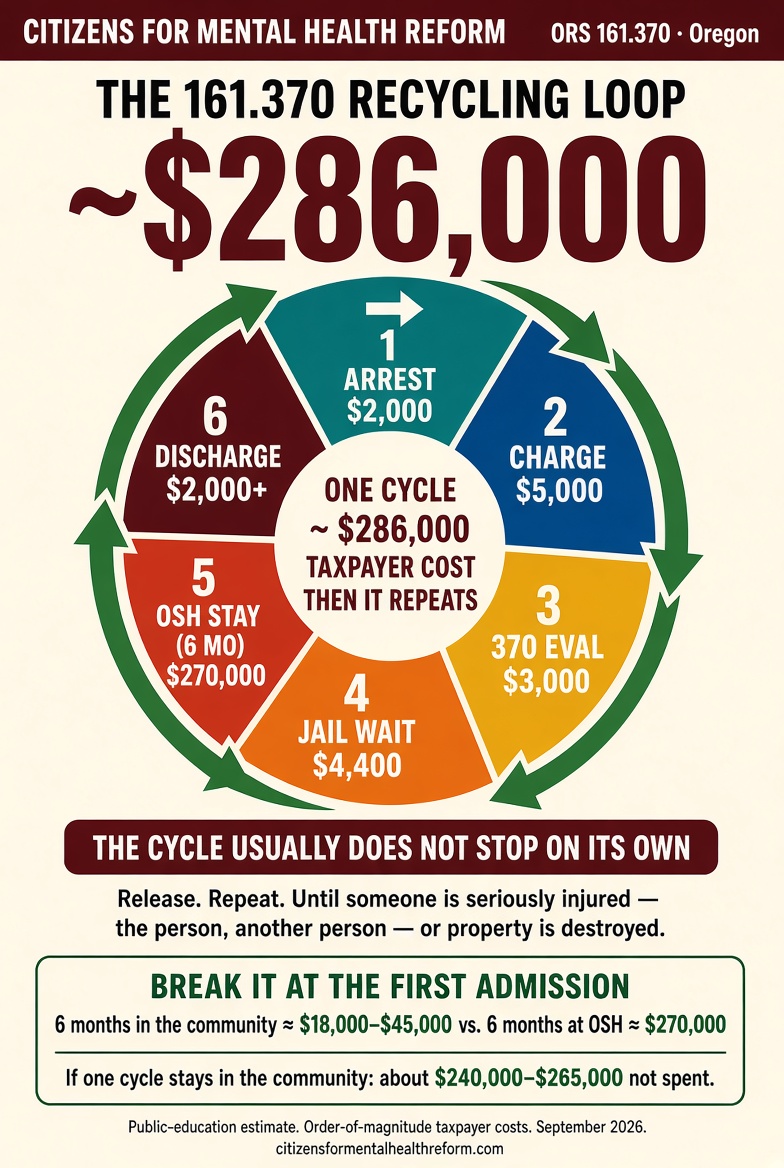
Public-education estimate. Order-of-magnitude taxpayer costs. September 2026. citizensformentalhealthreform.com
One loop through the 161.370 system costs about $286,000: arrest, charge, fitness evaluation, jail wait, a six-month Oregon State Hospital stay, discharge. Then the person is released. Then it happens again. It usually does not stop until someone is seriously injured — the person, another person — or property is destroyed. After a Measure 11 offense they often become a long-term hospital patient.
Break it at the first admission
The same six months in the community costs about $18,000 to $45,000. If one cycle stays in the community, the state does not spend about $240,000 to $265,000. That number does not include victim harm or the later long stay.
Stop it at the first admission.
This is not a new crime. Use existing civil commitment and assisted outpatient treatment law. Do not allow commitment for homelessness alone or drugs alone. A judge still has to find a mental disorder and either danger or inability to meet basic needs. Street living and a positive drug test at arrest are evidence. They are not a separate checkbox.
What the bill should do
- Same-week investigation trigger. At the first 161.370 finding, if the person has a serious mental illness, is homeless, was arrested for a crime, and tested positive for drugs at county booking, the county community mental health program shall open a civil-commitment investigation that week. Do not send that person back to the street as the default.
- Treat and house, then keep the order on. If the person qualifies, enter a civil order: treatment, housing, and medication as the court already may require. When they leave the hospital they go to supervised or subsidized housing with the order still in force.
- Revoke without waiting for the next arrest. If a person under that order leaves treatment or housing, or decompensates, the court or designated director may return them to a hospital or locked residential bed. Do not wait for the next 370.
- Beds first in Salem. Plan mixed capacity on unused and underused state land on and next to the Oregon State Hospital Salem campus — land that can be reappropriated. Mix hospital beds, locked residential beds, step-down beds, and supervised housing. When they leave that campus they go to permanent subsidized housing with the court order still in place.
- The civil-commitment off-ramp takes effect after suitable housing exists. Do not flip the switch until designated beds and housing are open. Phase the operative date to inventory.
- Pay for the housing fix. Include a Policy Option Package and a federal funding request (Medicaid, HUD, SAMHSA) so Oregon can ask the federal government to help fund permanent subsidized housing tied to this off-ramp.
Path
First arrest / first 370 → same-week civil investigation if they meet the facts above → civil order if they qualify under current law → treat → community with strings → revoke to a bed if they walk away → permanent subsidized housing → released from the mechanism on successful recovery and stability.
The goal is to break the cycle before the serious injury, and to give people a roof that does not disappear when the hospital door opens.